
Financial & Economic Challenges in Elderly Care Homes — Building Sustainable, Energy-Efficient and Automated Facilities for the Future
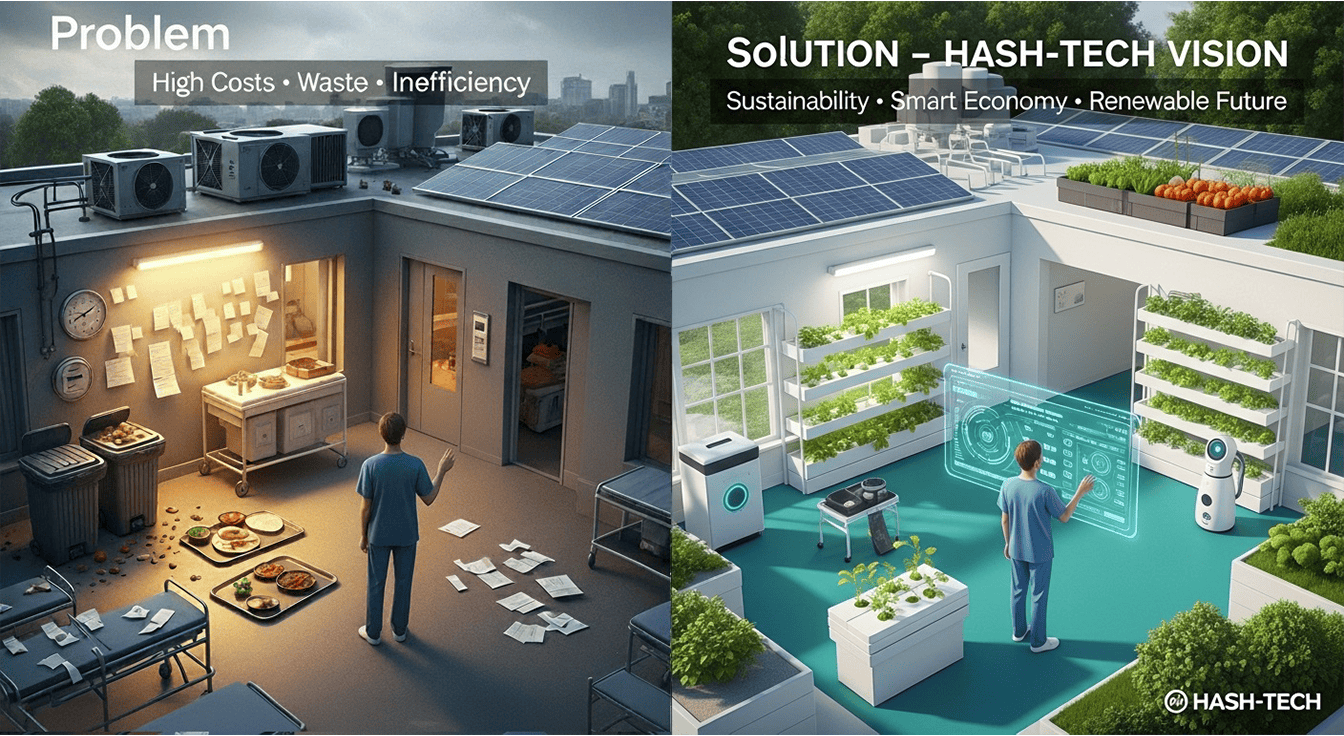
The Growing Financial Pressure in Elderly Care
Elderly care facilities worldwide are facing a perfect storm of rising operational costs, staff shortages, and tightening budgets.
According to the OECD, the average long-term care expenditure is projected to rise from 1.7% to 3.5% of GDP by 2050, while many nursing homes already operate on razor-thin margins.
At the same time, energy costs have increased by over 40% in Europe in the last decade.
The challenge is clear: how can we maintain high-quality, person-centered care without compromising financial sustainability?
Hash-Tech’s integrated vision for Nursing Home Automation answers this question by combining energy-efficient architecture, renewable energy, AI-based management systems, and robotic logistics into one cohesive economic ecosystem.
💡 The Integrated Solution: Financial Resilience Through Smart Infrastructure
1️⃣ Energy-Efficient Architecture
A significant portion of a care home’s expenses—up to 35%—is consumed by energy costs.
Our solution introduces passive architectural design principles such as:
- Natural ventilation to reduce HVAC dependency.
- High-grade insulation and smart shading systems for temperature balance.
- Daylight-optimized layouts that lower lighting costs while enhancing resident wellbeing.
These measures can lower energy consumption by up to 45% while improving comfort and air quality—key elements of eco-architecture for robotic assisted nursing homes.
2️⃣ Solar Panels & Green Micro-Farms
Hash-Tech’s vision extends beyond automation — it embraces sustainability as a core economic strategy.
By integrating solar panels on rooftops and green micro-farms adjacent to facilities, nursing homes can:
- Generate clean, renewable energy to power robots and systems.
- Produce fresh, organic food for residents, reducing external food dependency.
- Lower operational carbon footprints significantly.
This dual-purpose infrastructure aligns with ESG (Environmental, Social, Governance) goals while ensuring long-term financial autonomy.
3️⃣ Smart Resource Tracking
Through IoT-based metering and robotic logistics, Hash-Tech’s system continuously monitors water, electricity, gas, and supply usage.
TrollyBot, for instance, integrates seamlessly with the smart inventory network — automatically optimizing delivery routes, meal portions, and laundry loads.
The result?
- Reduced waste.
- Accurate consumption analytics.
- Predictive reordering to eliminate overstocking or shortages.
This smart ecosystem turns every robot into an economic sensor, contributing to intelligent budgeting and resource optimization.
4️⃣ AI-Powered Budget Optimization & Preventive Maintenance
Traditional facilities often face unexpected breakdowns that lead to budget overruns of up to 20% annually.
Our AI-based maintenance and budgeting platform analyzes equipment data, predicting issues before failure occurs.
It also dynamically allocates resources — optimizing staff scheduling, therapy device usage, and even energy loads based on real-time occupancy.
This ensures a predictable, efficient financial ecosystem across all units of a Robotic Assisted Nursing Home.
5️⃣ Hydroponic and Vertical Gardens
In addition to micro-farms, integrating hydroponic or vertical gardens inside the facility provides:
- Year-round access to fresh vegetables and herbs.
- Therapeutic engagement opportunities for residents.
- Reduced food transportation costs and carbon emissions.
These gardens serve dual purposes — promoting Robotic Assisted Occupational Therapy by involving residents in light gardening activities while enhancing sustainability.
6️⃣ Recycling & Waste Segregation Robots
Automation doesn’t end with care tasks.
Recycling and waste segregation robots autonomously identify and sort recyclable, organic, and hazardous waste using computer vision and AI.
This significantly reduces human exposure, improves hygiene, and ensures compliance with environmental standards.
With automated waste management, facilities can cut disposal costs by up to 30%, while promoting a circular economy model within the nursing home environment.
7️⃣ Rainwater Harvesting & Smart Irrigation
A closed-loop water management system collects, filters, and stores rainwater, which is then used for cleaning, irrigation, and cooling.
Smart irrigation, driven by AI-based soil sensors, ensures plants in the green micro-farm and vertical gardens receive the precise amount of water they need—no more, no less.
This reduces water waste by up to 50%, an essential saving in regions facing increasing droughts or water costs.
8️⃣ Eco-Architecture Using Renewable Materials
The construction phase is as crucial as operation.
By adopting low-carbon materials such as cross-laminated timber (CLT), bamboo composites, and recycled steel, the carbon footprint of new nursing homes can drop by 60–70% compared to traditional builds.
Combined with modular, scalable design, this allows for faster deployment and easier maintenance — ideal for expanding Robotic Assisted Nursing Homes across regions.
🌍 A Sustainable Future of Care
Hash-Tech’s holistic approach doesn’t just aim for financial efficiency — it redefines the economic model of elderly care.
By merging nursing home automation with green energy, intelligent architecture, and circular sustainability, we enable a model where:
- Facilities operate with near-zero waste.
- Robots like TrollyBot optimize supply and logistics costs.
- AI ensures predictive maintenance and precise budgeting.
- Green infrastructure generates both food and power.
The result is a financially sustainable, ecologically balanced, and technologically empowered elderly home — a true evolution toward the Robotic Assisted Nursing Home of the future.