
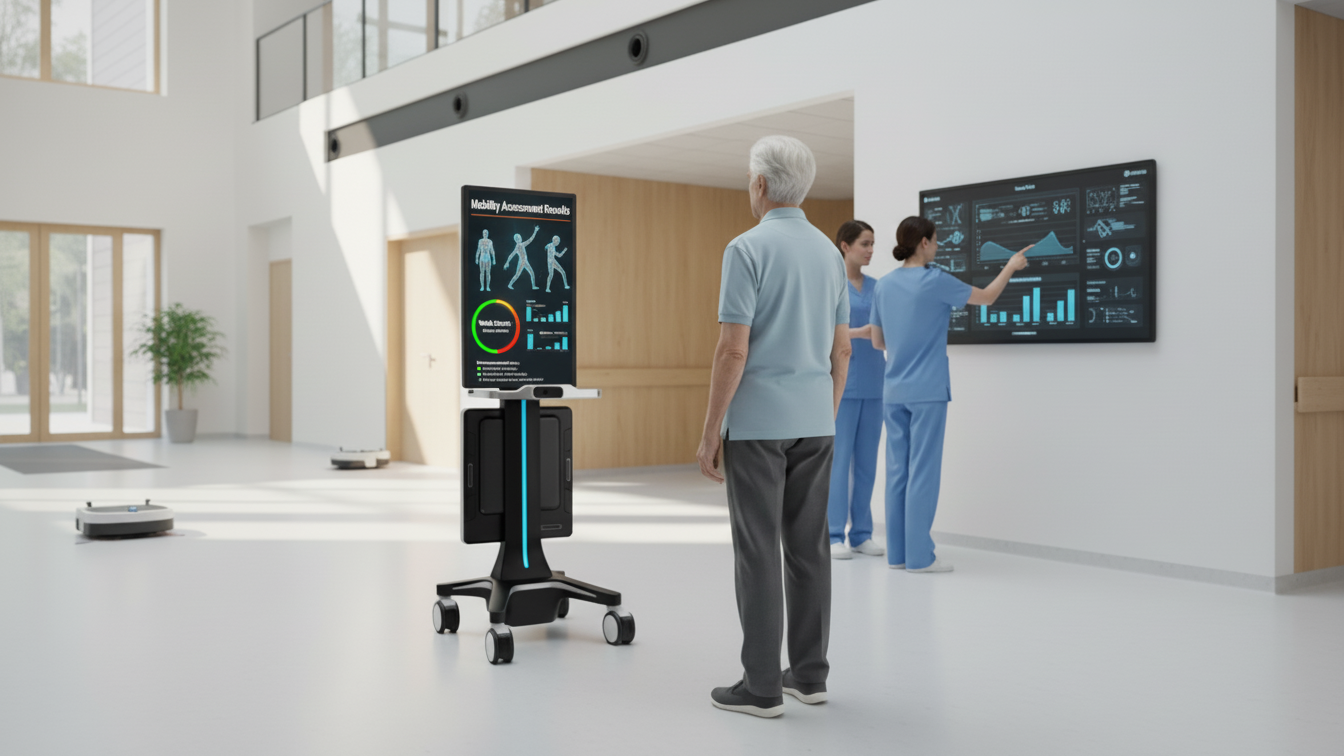
The #1 Strategic Investment: Why Senior Joint Mobility Assessment Is Essential for Modern Care Providers
Senior joint mobility assessment is no longer a clinical add-on or a periodic measurement task. It has become a strategic, operational, and financial cornerstone for modern elderly care providers navigating staff shortages, rising fall-related costs, and increasing regulatory pressure.
Across Europe, more than 150 million people are aged 60+, and musculoskeletal limitations remain one of the leading contributors to loss of independence, institutionalization, and preventable hospital admissions (Eurostat, WHO). For care providers, this reality demands a shift—from reactive therapy toward systematic, data-driven mobility intelligence.
This is why Senior joint mobility assessment must be treated as a core infrastructure investment, on par with staffing, safety systems, and building automation.
Senior Joint Mobility Assessment as the Foundation of Modern Elderly Care
Senior joint mobility assessment provides objective insight into Functional Movement, joint range of motion, asymmetries, stiffness, hypomobility, and early biomechanical decline. These parameters directly determine fall risk, rehabilitation success, and long-term care costs.
Traditional assessment methods rely heavily on manual goniometry, visual observation, and episodic testing—approaches that are time-consuming, subjective, and inconsistent. In contrast, Automated Mobility Assessment systems allow care teams to continuously monitor mobility trends, enabling Automated Geriatric Fall Risk Assessment across entire resident populations.
Clinical research shows that 30–40% of adults over 65 experience measurable joint mobility limitations that significantly affect daily activities, balance, and gait stability.

From Clinical Insight to Strategic Advantage
For care operators, Senior joint mobility assessment is not just about therapy—it is about risk mitigation, workforce efficiency, and financial sustainability.
Falls alone cost European healthcare systems tens of billions of euros annually, with hip fractures and mobility-related injuries being the most expensive outcomes. Effective Fall Prevention for Seniors starts with early detection of declining joint mobility and compensatory movement patterns.
By embedding Elder Mobility Assessment into daily operations, providers reduce emergency interventions, hospital transfers, and long rehabilitation cycles—while protecting caregivers from physical strain.
Enabling Nursing Home Automation Through Mobility Intelligence
Senior joint mobility assessment is a key enabler of true nursing home automation. Without precise mobility data, automation remains superficial.
Modern Robotic assisted nursing home environments depend on accurate biomechanical inputs to function safely and effectively. Objective joint mobility data informs:
-
Robotic assisted rehabilitation protocols
-
Adaptive Robotic assisted Ergotherapy
-
Personalized Robotic assisted Occupational therapy
This data-driven approach ensures therapy is precise, measurable, and scalable, rather than generalized or reactive.
The Role of Hash-Tech Solutions in Senior Joint Mobility Assessment
At Hash-Tech, we have built an integrated ecosystem where Senior joint mobility assessment becomes operational reality, not theory:
-
PhysioEye – Medical-grade, 3D AI-powered Automated Mobility Assessment platform
-
ErgoBot – Precision Robotic assisted rehabilitation for lower- and upper-limb mobility
-
SeniorFit – Strength, balance, and Functional Movement training for seniors
-
TrollyBot – Autonomous logistics enabling full nursing home automation
Together, these systems transform Senior joint mobility assessment into a continuous, automated, and actionable clinical intelligence layer.
Why Care Providers Must Act Now
Care facilities across Europe face an estimated shortage of 280,000–690,000 caregivers by 2049 (German Federal Statistical Office; OECD). In this environment, relying solely on manual assessments is no longer viable.
By investing in Senior joint mobility assessment, providers can:
-
Multiply therapist productivity
-
Reduce caregiver injury risk
-
Standardize Geriatric Physical Therapy delivery
-
Improve outcomes in Elderly Care Solutions
-
Strengthen compliance and documentation
This is not technology replacing humans—it is technology protecting both residents and caregivers.
A Strategic Imperative for the Future of Care
Senior joint mobility assessment represents the convergence of clinical excellence, operational efficiency, and long-term sustainability. It underpins safer environments, enables intelligent automation, and supports personalized care at scale.
At Hash-Tech, our leadership in deploying these systems across Bayern, with active projects in Munich and Buchbach, positions us at the forefront of next-generation elderly care infrastructure in Germany.
The future of care is not reactive.
It is measured, automated, predictive, and mobility-driven—and it starts with Senior joint mobility assessment.