
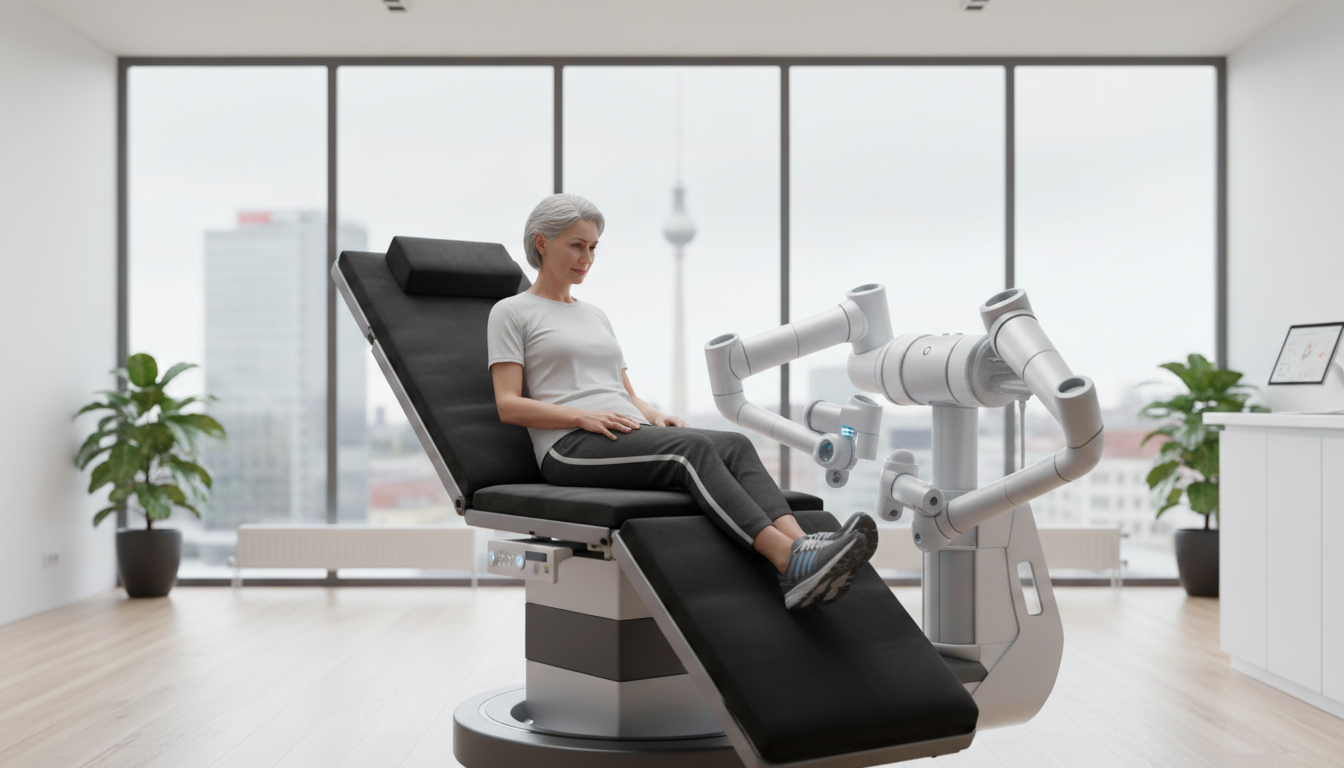
Robotic Hip Fracture Rehabilitation: Revolutionizing German Elder Care with ErgoBot’s Precision
Robotic Hip Fracture Rehabilitation is no longer just a luxury—it is a clinical necessity for Germany’s aging population. Every year, hospitals in Germany treat approximately 120,000 proximal femoral fractures, a number that places an immense financial burden on our healthcare system. The total cost of fragility fractures in Germany reached an estimated €13.8 billion in 2019, yet patient outcomes remain dangerously inconsistent.
At Hash Tech GmbH, we are deploying Robotic Hip Fracture Rehabilitation to close the “Treatment Gap.” By integrating ErgoBot and PhysioEye into the standard of care, we are replacing subjective manual therapy with data-driven precision.
The Crisis: Why Manual Therapy Cannot Keep Up
The demand for Robotic Hip Fracture Rehabilitation is driven by a critical shortage of human hands. Germany is currently facing a deficit of over 11,600 physiotherapists, leaving many facilities unable to provide the intensive therapy required for recovery. This shortage has lethal consequences. The mortality rate for elderly hip fracture patients in Germany is shocking: 25–30% within the first six months. Without consistent, high-repetition mobilization, patients develop secondary complications like pneumonia and thrombosis. Robotic Hip Fracture Rehabilitation solves this by allowing a single therapist to oversee multiple patients simultaneously, ensuring that no patient is left bedridden due to staffing gaps.
ErgoBot: The Engine of Robotic Hip Fracture Rehabilitation
To lower mortality rates, we must increase movement frequency. ErgoBot is the cornerstone of our Robotic Hip Fracture Rehabilitation suite. Unlike a human therapist who fatigues after 15 minutes of heavy lifting, ErgoBot provides consistent, therapist-defined mobilization for Hip Flexion/Extension and Abduction/Adduction. This allows for Robotic Assisted Occupational Therapy that is both safe and scalable. The robot’s sensors detect the patient’s slightest resistance, adapting the motion in real-time to prevent pain while maximizing the therapeutic range of motion (ROM).
PhysioEye: Eliminating the “Blind Spot” in Recovery
A successful Robotic Hip Fracture Rehabilitation program requires more than just movement; it requires accurate data. Clinical studies show that hip fracture burden is projected to double worldwide by 2050, yet most facilities still rely on the “naked eye” to judge recovery. PhysioEye changes this by performing a continuous Automated Mobility Assessment. It tracks Gait Analysis metrics such as step length and stance symmetry. This ErgoBot PhysioEye integration provides the objective evidence needed to prove that a patient is ready to transition from a Robotic Assisted Nursing Home back to independent living.
Economic Impact: ROI for Insurers and Investors
For investors, Robotic Hip Fracture Rehabilitation represents a massive efficiency arbitrage. Inpatient treatment and rehabilitation for a hip fracture in Germany can cost upwards of €27,000 per case. By reducing the length of stay and preventing readmissions through Predictive Care, Hash Tech’s systems drastically improve the facility’s bottom line. Furthermore, our Longitudinal mobility assessment provides the irrefutable data required for optimal Pflegegrad classification. This ensures that care homes receive the correct reimbursement level for the high-quality Robotic Hip Fracture Rehabilitation they provide.
Comprehensive Care with SeniorFit and TrollyBot
Robotic Hip Fracture Rehabilitation does not end at the hip. To prevent the next fall, we must strengthen the whole body. SeniorFit acts as a “Smart Gym,” using adaptive resistance to build core stability and prevent Arthritis prevention. Meanwhile, TrollyBot handles the logistics of the ward, ensuring that staff can focus entirely on the patient. This holistic approach is what defines modern Elderly Care Solutions.
From our headquarters in Buchbach, Hash Tech GmbH is engineering the future of Robotic Hip Fracture Rehabilitation. Our systems are designed to meet the rigorous standards of the German healthcare market, supporting clinics in Munich and across Bayern. We are not just selling robots; we are exporting a new standard of care—one where Robotic Hip Fracture Rehabilitation ensures that a fracture is a hurdle, not a finish line.
Conclusion
The data is clear: the manual model is broken. With Robotic Hip Fracture Rehabilitation, we can save lives, reduce costs, and restore dignity. It is time for Germany’s healthcare leaders to embrace Nursing Home Automation and make Robotic Hip Fracture Rehabilitation the new standard.