
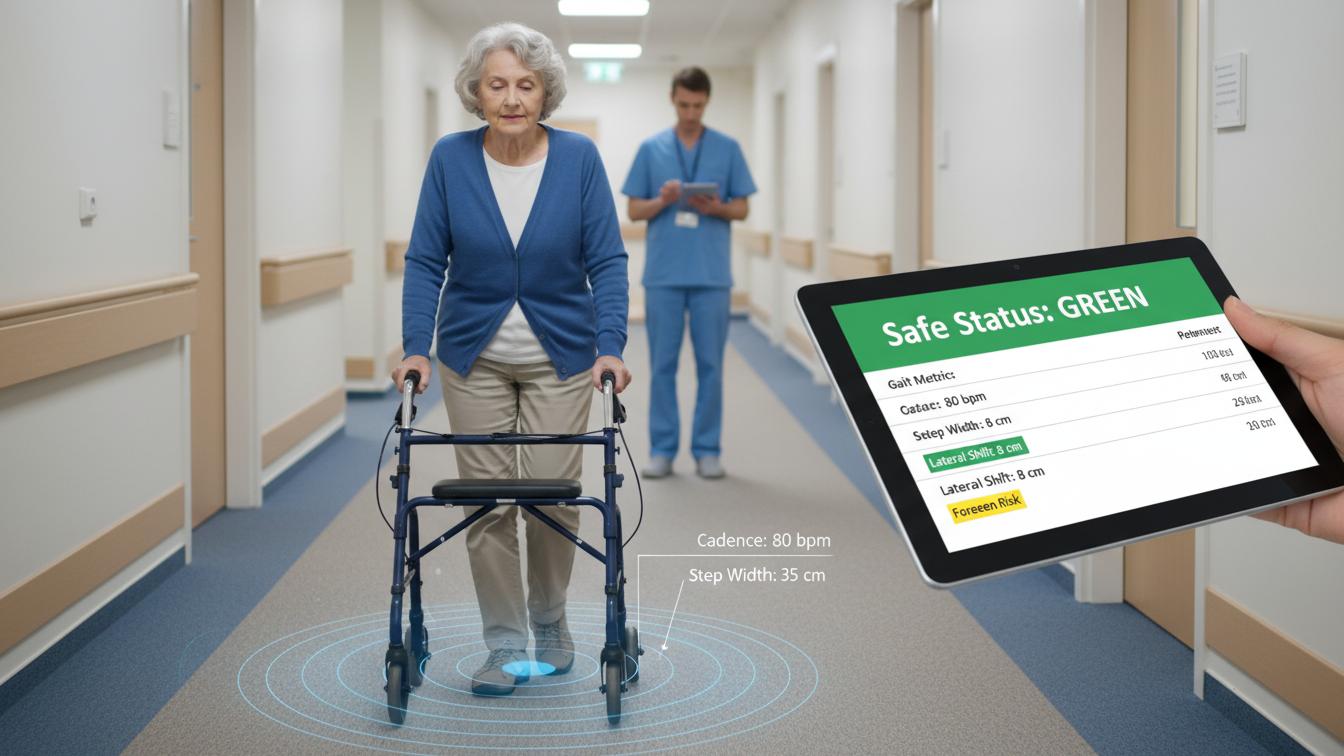
How Predictive Gait Analysis Secures Higher Pflegegrad Accuracy and Reduces Facility Liability
In the competitive landscape of German elderly care, the margin between financial stability and deficit often rests on two factors: accurate insurance classification and the prevention of high-liability events. Predictive Gait Analysis has emerged as the most critical technological advancement in Nursing Home Automation, providing the objective data needed to navigate the complexities of the Pflegegrad system and liability law.
Securing Pflegegrad Accuracy with Objective Data
The German Pflegegrad system relies heavily on the “degree of independence.” When the Medizinischer Dienst (MD) evaluates a resident, subjective observations often lead to under-classification, costing facilities thousands of Euros in unclaimed care funding.
By integrating Predictive Gait Analysis through PhysioEye, facilities can present undeniable, 3D-mapped evidence of a resident’s mobility limitations.
-
Spatio-Temporal Evidence: Tracking parameters like “Double Support Time” and “Step Length Asymmetry” provides a scientific basis for proving “severe impairment of mobility.”
-
Medical Necessity: A Predictive Gait Analysis report acts as a professional Elder Mobility Assessment, standardizing the documentation required for higher care grades.
-
Proactive Re-evaluation: Don’t wait for the annual review. When Predictive Gait Analysis detects a 10% decline in gait speed (a key marker of mortality and frailty according to JAMA), the system triggers a Senior joint mobility assessment to justify a grade upgrade immediately.
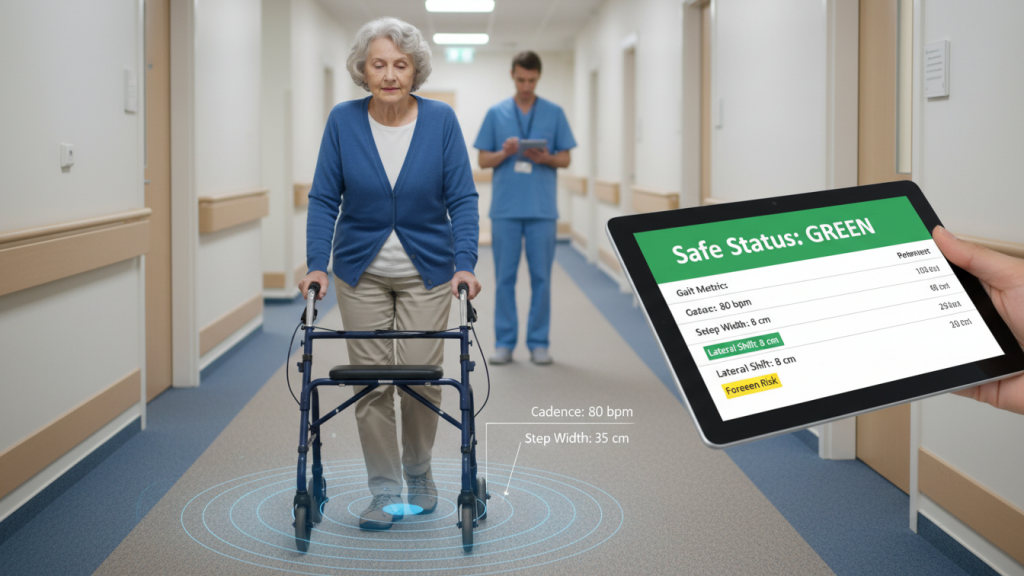
The Clinical “Why”: Interpreting Key Biomarkers in Predictive Gait Analysis
To understand why Predictive Gait Analysis is so effective at reducing liability, we must look at the specific biomarkers PhysioEye captures. Each metric is a window into the resident’s neurological and musculoskeletal health.
-
The Significance of Double Support Time: This refers to the phase where both feet are on the ground. Research indicates that as stability decreases, residents naturally increase their double support time to compensate for a fear of falling. An increase in this metric is a leading indicator of Automated Geriatric Fall Risk Assessment, as discussed in this study on gait variability.
-
Vertical Oscillation & Energy Efficiency: Healthy gait minimizes the vertical movement of the Center of Mass (CoM). Excessive oscillation detected during Predictive Gait Analysis suggests that the resident is wasting energy, leading to “fatigue-induced falls.” Correcting this via Robotic Assisted Rehabilitation is vital for long-term mobility.
-
Toe-Out Angle & Knee Health: In many seniors, an increased “toe-out” angle is a compensatory mechanism for medial knee osteoarthritis. PhysioEye tracks these subtle shifts to prevent joint degradation, allowing for early referral to Robotic Assisted Occupational Therapy.
-
Asymmetry as a Neurological “Red Flag”: Left-to-right gait asymmetry is often the first sign of sub-clinical neurological events. By catching asymmetry early through Predictive Gait Analysis, care teams can initiate Robotic Assisted Ergotherapy before a major stroke or cognitive decline occurs.
Mitigating Liability through Fall Prevention for Seniors
Falls are the leading cause of liability claims against nursing homes. Standard care often fails to document “foreseeability”—a key legal requirement in liability defense.
A digital Predictive Gait Analysis creates a “Digital Paper Trail” of safety:
-
Evidence of Supervision: Utilizing PhysioEye proves that the facility is using the highest available standard for Automated Mobility Assessment.
-
Trendelenburg Sign Detection: By identifying lateral shifts in the pelvis, Predictive Gait Analysis flags hip instability weeks before a fall occurs. This allows for the immediate deployment of Robotic Assisted Rehabilitation.
-
Customized Care Plans: Data from Predictive Gait Analysis ensures that residents are prescribed the correct Robotic Assisted Occupational Therapy, reducing the likelihood of negligence claims.
The Economic Impact of Kinematic Precision
Investing in Predictive Gait Analysis is not just a clinical choice; it is a financial strategy.
-
Workforce Efficiency: In a Robotic Assisted Nursing Home, PhysioEye automates the Automated Geriatric Fall Risk Assessment, saving staff hours spent on manual goniometry.
-
Integration with Robotics: The metrics from a Predictive Gait Analysis are sent directly to ErgoBot and SeniorFit, ensuring that Robotic Assisted Ergotherapy is always tailored to the resident’s current 3D gait profile.
-
Logistic Support: Even non-clinical robots like TrollyBot benefit from a facility where Predictive Gait Analysis identifies the safest walking paths for residents.
Conclusion: Data is the Best Defense
Whether you are defending a Pflegegrad classification or a liability claim, the subjective opinion of a caregiver is no longer enough. Predictive Gait Analysis provides the objective truth.
By implementing PhysioEye, your facility transitions from guessing to knowing. This is the ultimate promise of Nursing Home Automation: protecting your residents with Predictive Gait Analysis while protecting your bottom line.
👉 Discover how PhysioEye secures your facility’s future
👉 Book a consultation in Buchbach
Technical References for Clinical Teams
-
Gait Asymmetry as a Fall Predictor: Gait & Posture Journal.
-
The Sixth Vital Sign: Journal of Geriatric Physical Therapy.
-
AI in Frailty Detection: ResearchGate: Managing Gait Disorders in Nursing Homes.