
ICU Acquired Weakness: How ErgoBot Helps Prevent the Structural Aftermath of Critical Care
ICU Acquired Weakness is increasingly recognized as one of the most debilitating consequences of modern critical care. While intensive care teams in Germany excel at saving lives from sepsis, trauma, and respiratory failure, many survivors leave the ICU with profound functional limitations. ICU Acquired Weakness is not limited to neuromuscular impairment alone; prolonged immobility frequently leads to secondary musculoskeletal complications that persist long after discharge.
A growing body of literature confirms that musculoskeletal complications following critical illness—such as joint contractures, loss of range of motion, and abnormal tissue remodeling—are widespread, yet often addressed too late. Once patients awaken unable to move effectively, the window for prevention has already closed, severely impacting their future Senior independence.
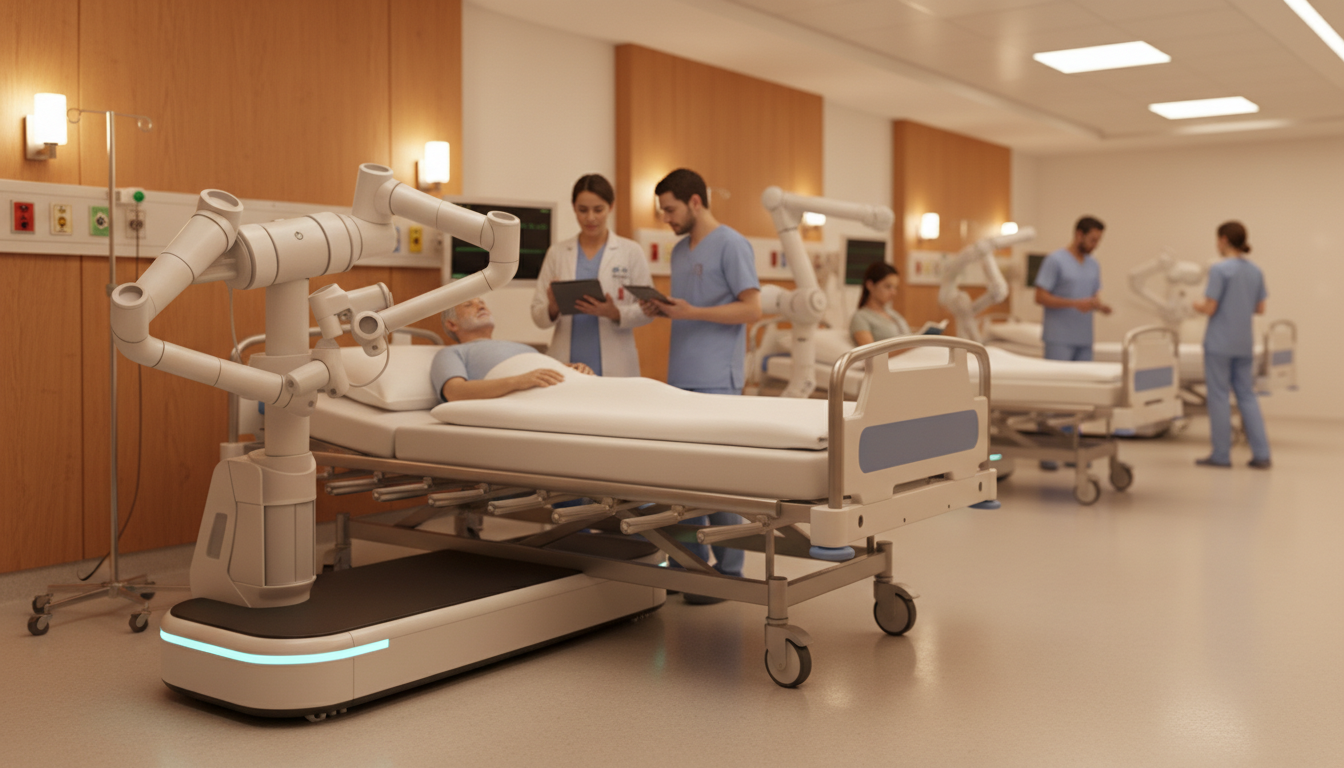
At Hash Tech GmbH, we treat mobility as a vital sign. This philosophy led to the design of ErgoBot, a fully mobile robotic system capable of delivering Robotic ICU Rehabilitation directly at the bedside—precisely where ICU Acquired Weakness begins.
ICU Acquired Weakness and the Hidden Burden of Structural Damage
ICU Acquired Weakness is classically defined by Critical Illness Myopathy (CIM) and Critical Illness Polyneuropathy (CIP). However, prolonged immobilization during sedation often triggers secondary structural damage that amplifies long-term disability.
Clinical studies report that joint contractures develop in more than 30% of long-stay ICU patients, significantly limiting post-ICU rehabilitation potential. In parallel, Heterotopic Ossification (HO)—abnormal bone formation in soft tissue—has been associated with prolonged immobility and systemic inflammation. These complications are mechanical in nature and, once established, are largely irreversible.
Without Robotic Assisted Rehabilitation in the early stages, joints progressively lose elasticity. Manual therapy alone is frequently constrained by staffing limitations, making it difficult to prepare patients for future Elder Mobility Assessment protocols once they leave the ICU.
Breaking the Bedside Barrier in ICU Acquired Weakness Prevention
One of the greatest barriers to addressing ICU Acquired Weakness is not clinical knowledge—it is access. ICU beds are surrounded by ventilators and monitoring equipment, creating a structural constraint that limits physical intervention.
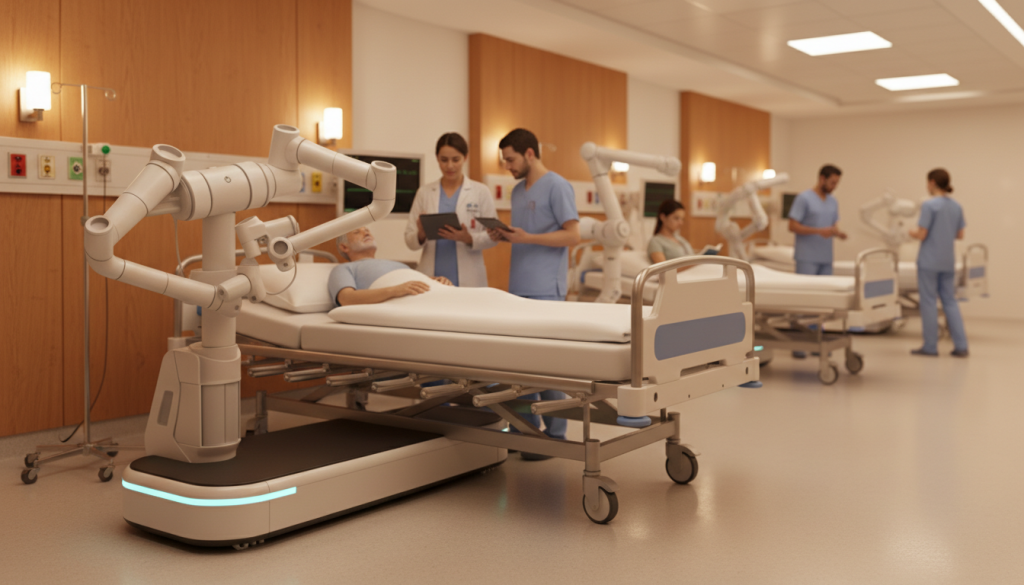
ErgoBot was engineered specifically to overcome this challenge. Unlike gym-based systems, ErgoBot is compact and rolls directly into ICU rooms. It enables Robotic Assisted Occupational Therapy and lower-limb mobilization without moving the patient.
By eliminating the need to transport patients, ErgoBot makes intervention feasible for individuals traditionally considered “too difficult to mobilize.” This proactive approach is a cornerstone of Predictive Care, ensuring that patients do not deteriorate to the point where they become permanent residents of a Robotic Assisted Nursing Home.
Passive Mobilization: A Critical Window Against ICU Acquired Weakness
The early phase of critical illness represents a narrow but decisive window. Research shows that skeletal muscle mass can decline by up to 2% per day, accelerating structural deterioration.
ErgoBot addresses this through fully passive, cyclic mobilization. This Robotic Assisted Ergotherapy approach gently moves joints through controlled ranges of motion even while patients remain sedated. This mechanical input helps preserve joint lubrication and reduce the risk of contracture formation—key secondary drivers of ICU Acquired Weakness.
By maintaining tissue integrity now, we ensure that accurate Senior joint mobility assessment and Automated Mobility Assessment are actually possible in the recovery phase.
ICU Acquired Weakness Meets the Therapist Shortage in Germany
The clinical need for early mobilization directly collides with workforce reality. Germany faces a shortage of over 11,000 physiotherapists. In many ICUs, manual mobilization occurs only two to three times per week—insufficient to counter ICU Acquired Weakness.
ErgoBot functions as a clinical force multiplier. A single therapist can supervise therapy while attending to other patients. This model aligns ICU Acquired Weakness prevention with the modern demands of Elderly Care Solutions, ensuring consistent care independent of staffing fluctuations.
Preventing the Long-Term Cost of ICU Acquired Weakness
The true cost of ICU Acquired Weakness emerges after discharge. Patients who develop severe contractures often require lifelong assistance, placing significant strain on Nursing Home Automation environments.
Furthermore, profound physical disability leads to a higher Pflegegrad classification, increasing long-term insurance costs. Patients who leave the ICU with preserved joint mobility are far better candidates for Longitudinal mobility assessment and progressive recovery. Preventing structural damage during ICU stays is therefore not only a clinical priority but an economic one.
Regional Leadership from Bayern: From ICU Survival to Functional Recovery
From its engineering hub in Buchbach, Hash Tech GmbH is advancing the standard of ICU Acquired Weakness prevention across Bayern and Germany. In collaboration with clinical partners in Munich, we are demonstrating how early, automated mobilization protects patient independence. With ErgoBot, ICU survival is no longer the endpoint—it is the beginning of functional recovery.