
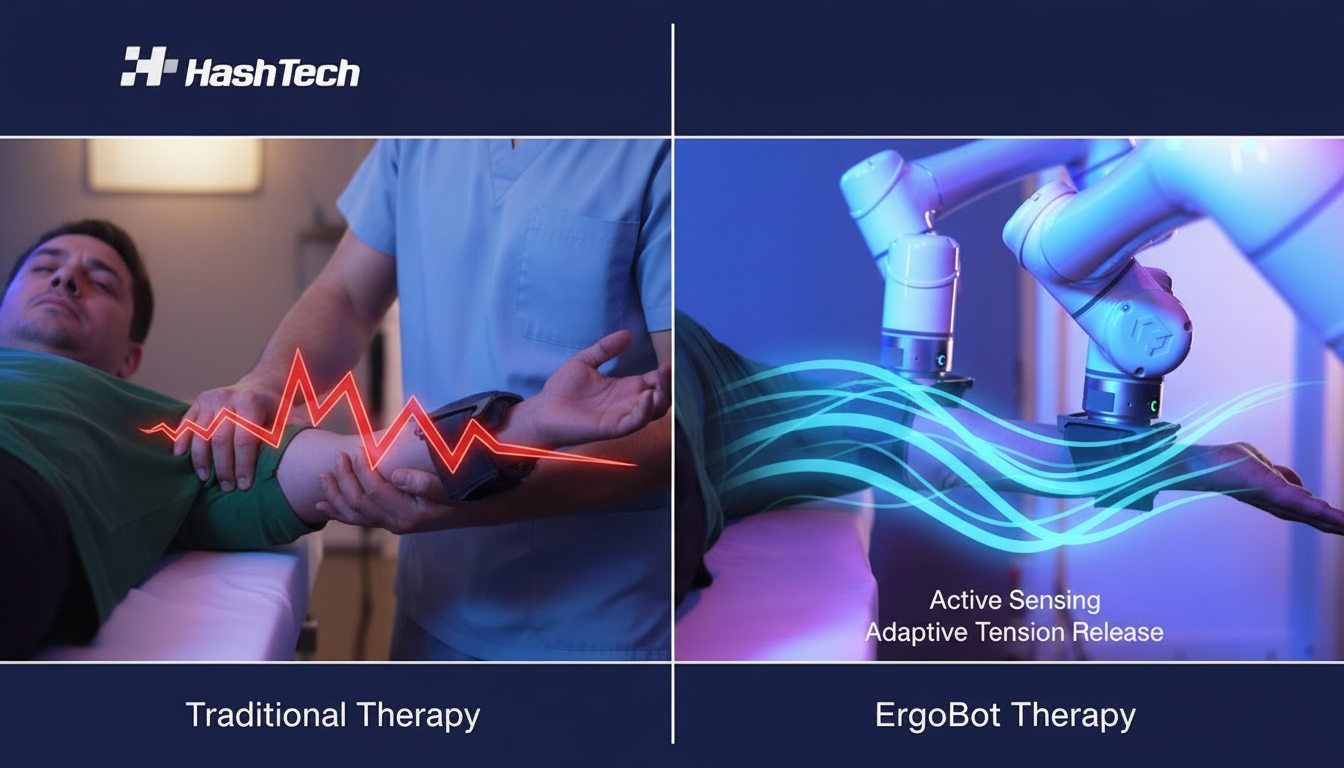
Spasticity Treatment: Why ErgoBot’s Active Sensing is Safer Than Manual Stretching
Spasticity Treatment is one of the most challenging aspects of neurological recovery in long-term care facilities. Relying exclusively on manual stretching introduces significant clinical risk, as human therapists cannot precisely measure or instantly react to the sudden, velocity-dependent resistance of a spastic muscle.
Hash Tech GmbH introduces a safer, technology-driven standard for Spasticity Treatment. By deploying the ErgoBot system, clinics utilize active sensing and dynamic impedance control to deliver a protective, automated approach to Spasticity Treatment, forming the core of our Elderly Care Solutions and broader Nursing Home Automation initiatives.
The Clinical Reality of Spasticity
To understand why an advanced, sensor-driven Spasticity Treatment is necessary, we must examine the scope and precise definition of the condition. In post-stroke populations, the need for proactive Spasticity Treatment is critical.
The incidence of spasticity after the first-ever stroke with paresis was 39.5%.
Clinically, the condition is defined as a motor disorder characterised by a velocity dependent increase in tonic stretch reflexes. Because the muscular resistance depends entirely on the velocity of the movement, manual stretching without integrated force sensors poses an inherent risk. If a therapist pushes slightly too fast against a sudden spastic catch, it can cause severe pain, joint inflammation, and soft tissue micro-tears.
The Danger of Manual Intervention vs. Active Sensing
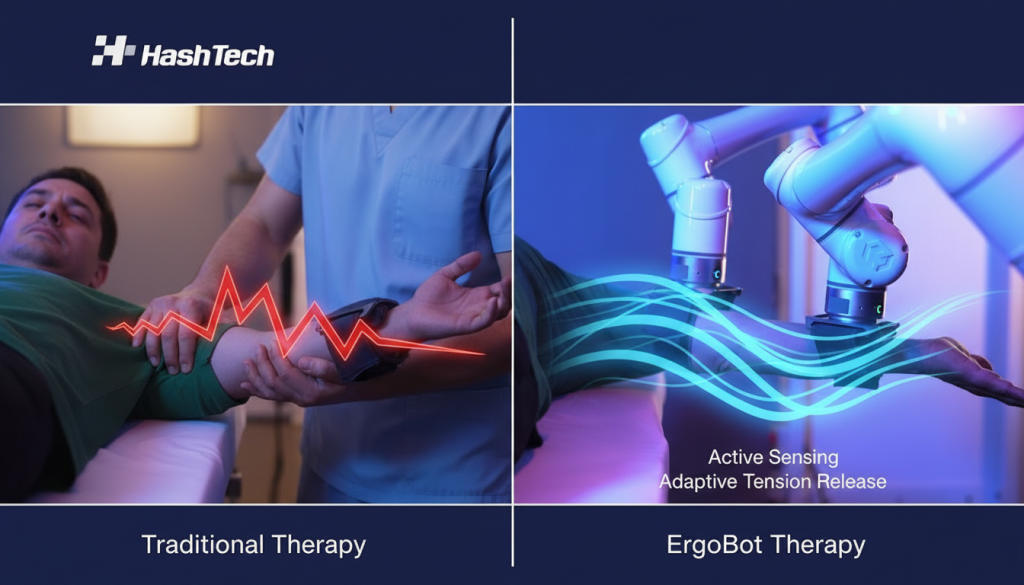
A safe Spasticity Treatment protocol must dynamically adapt to the patient’s immediate muscle tone in real-time. Human hands lack the micro-second reaction time required to completely drop the applied force the moment an involuntary reflex occurs.
ErgoBot solves this through active sensing technology. Our robotic system utilizes precise algorithms where impedance control is a widely-used technique for regulating the levels of assistance provided by robotic systems during rehabilitation training. When ErgoBot detects the exact millisecond a muscle resists the movement, the system instantly modulates the damping and applied torque. It yields to the patient’s resistance, preventing soft tissue damage and ensuring the Spasticity Treatment remains entirely safe and pain-free.
Core Rehabilitation Trainings Powered by Active Sensing
ErgoBot executes the most critical rehabilitation exercises required for neurological recovery. ErgoBot seamlessly performs Continuous Passive Motion (CPM) to gently maintain joint flexibility and prevent contractures in severely impaired limbs. As motor control improves, the system shifts to active-assisted training, providing just enough motorized support to help the resident complete functional, daily movements like reaching and guiding. For more advanced recovery, active-resisted training applies a highly controlled, adaptable counter-force to safely rebuild muscle strength. By automating these essential therapeutic exercises, the system ensures a highly consistent, progressive recovery pathway tailored to the exact capabilities of each individual resident.
The Economic Burden of Mismanagement
Failing to implement an effective, consistent Spasticity Treatment results in a massive financial drain on healthcare systems. The progression of joint stiffness and contractures inevitably leads to a severe loss of mobility, accelerating the patient’s Pflegegrad classification and demanding highly intensive daily care.
The longitudinal financial data highlights the absolute urgency for an upgraded standard of Spasticity Treatment.
Integration with Predictive Care
Combining the therapeutic capabilities of ErgoBot with the diagnostic precision of PhysioEye creates a seamless, data-driven workflow for Spasticity Treatment.
Once an early joint limitation is flagged during a Senior joint mobility assessment or an Automated Mobility Assessment, ErgoBot is immediately deployed to execute precise Robotic Assisted Occupational Therapy. This proactive intervention guarantees that your facility’s Spasticity Treatment is objective, safe, and highly scalable.
Regional Leadership in Bayern
From our engineering center in Buchbach, Hash Tech GmbH is redefining Spasticity Treatment across Munich and Bayern. By integrating active robotic sensing into daily clinical workflows, we are delivering the foundation of true Predictive Care.